
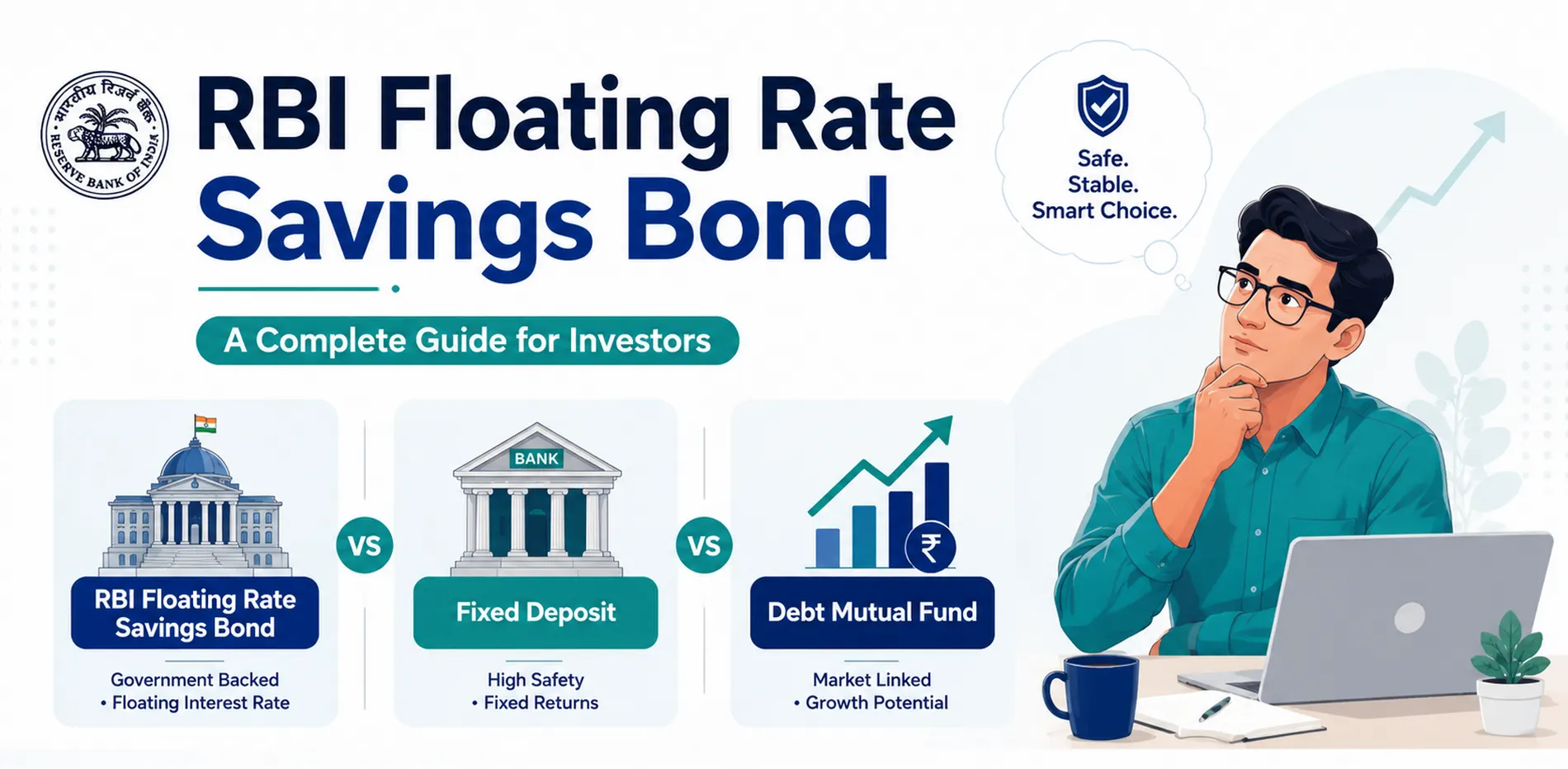
RBI Floating Rate Savings Bond: Interest Rate, Taxation, Returns & How to Buy Online
Introduction
For investors seeking stability over volatility, government-backed instruments play an important role in portfolio construction. The RBI Floating Rate Savings Bond is one such option that offers sovereign safety along with interest rates that adjust periodically.
However, while the product appears attractive on the surface, understanding its taxation and real post-tax returns is critical before allocating capital.
What is RBI Floating Rate Savings Bond?
RBI Floating Rate Savings Bonds are issued by the Reserve Bank of India on behalf of the Government of India. These bonds are designed primarily for conservative investors who prioritise capital protection and steady income.
Key features:
- Tenure: 7 years
- Minimum investment: ₹1,000
- Maximum investment: No limit
- Interest payout: Semi-annual
- Interest type: Floating (reset every 6 months)
- Safety: Sovereign guarantee
- Liquidity: Non-transferable and non-tradable
These bonds are held in a Bond Ledger Account and interest is directly credited to the investor’s bank account.
How Interest Rate Works
Unlike fixed deposits, the interest rate here is not fixed.
The rate is linked to the National Savings Certificate (NSC) rate plus a spread of 0.35 percent and is reset every six months, typically on January 1 and July 1.
For example, if the NSC rate is 7.7 percent, the bond will offer 8.05 percent annually for that period.
This structure ensures that returns adjust with interest rate cycles, but does not guarantee consistently high returns.
Taxation: The Most Important Factor
Taxation significantly impacts the effectiveness of this investment.
Interest earned is fully taxable under “Income from Other Sources” and added to your total income. The applicable tax depends on your slab.
There are no deductions under Section 80C or any other provision.
TDS may also be applicable on interest payments as per prevailing rules.
The key takeaway is that despite offering around 8 percent interest, the post-tax return can fall sharply for investors in higher tax brackets.
Post-Tax Return Reality (Illustration)
Assuming:
- Investment: ₹10 lakh
- Interest rate: 8%
- Tax slab: 30%
Annual interest = ₹80,000
Tax = ₹24,000
Net income = ₹56,000
Effective return = approximately 5.6% per annum
This highlights why taxation must be considered before investing.
Comparison with Other Fixed Income Options
| Parameter | RBI Floating Rate Bond | Bank FD | Debt Mutual Fund |
|---|---|---|---|
| Safety | Sovereign | High | Market-linked |
| Returns | Floating | Fixed | Market-linked |
| Taxation | Slab | Slab | Slab |
| Liquidity | Low | Moderate | High |
| Post-tax efficiency | Low | Low | Higher (long-term) |
Debt mutual funds tend to offer better tax efficiency over longer periods, while RBI bonds score highest on safety.
How to Buy RBI Floating Rate Savings Bonds Online
Investors can purchase these bonds through authorised banks using net banking.
Steps:
- Log in to your bank’s net banking or mobile app
- Go to Investments or Government Securities section
- Select RBI Floating Rate Savings Bond
- Enter investment amount
- Add nominee details
- Confirm transaction via OTP
After purchase:
- Bonds are held electronically
- Interest is credited directly to your bank account
Who Should Invest?
Suitable for:
- Retirees needing predictable income
- Conservative investors avoiding market volatility
- Investors prioritising capital safety
Not suitable for:
- Investors in 30% tax bracket seeking efficiency
- Those needing liquidity
- Long-term wealth creation goals
Key Takeaways
RBI Floating Rate Savings Bonds offer strong safety backed by the Government of India and interest rates that adjust with market conditions. However, full taxation and lack of liquidity reduce their effectiveness for many investors.
They work best as a stability component in a portfolio, not as a primary wealth-building tool.
Call to Action
Not all “safe” investments are efficient after tax.
If you want to structure your fixed income portfolio correctly based on your goals, timelines, and tax profile, get a personalised plan at capitagrow.com
Author Bio
Rajesh Narayanan is an AMFI-registered Mutual Fund Distributor and Founder of CapitaGrow. He helps investors manage their complete financial journey with a focus on disciplined investing, risk management and long-term wealth creation. He also conducts financial awareness sessions for corporates, schools and colleges.