
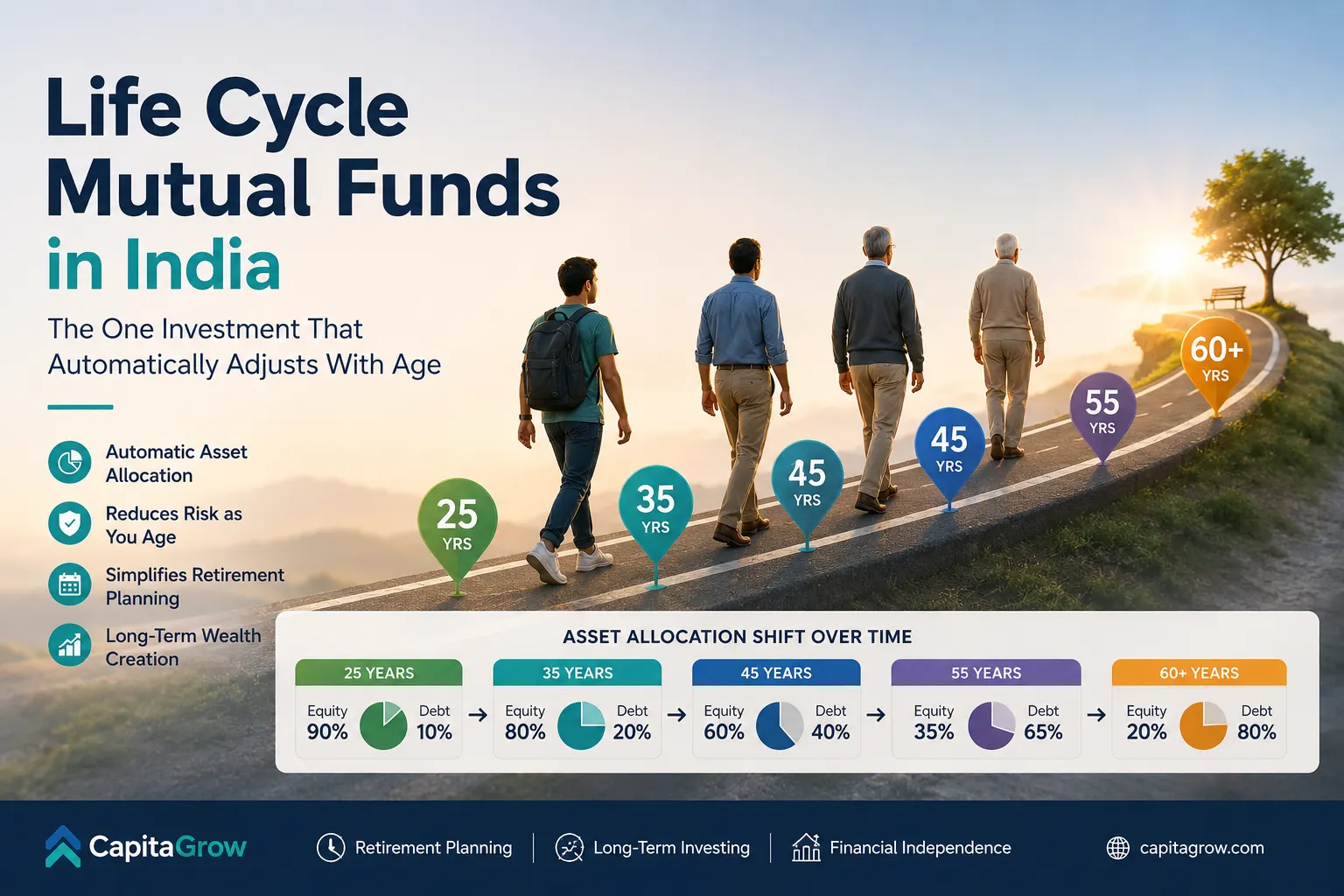
Life Cycle Mutual Funds in India: How SEBI’s New Funds Automatically Reduce Risk With Time
What if your mutual fund could gradually reduce equity exposure as your financial goal gets closer—without you having to rebalance the portfolio yourself?
That is the basic idea behind Life Cycle Mutual Funds.
Life Cycle Funds are a new mutual fund category introduced by SEBI in 2026. These funds have a predefined target maturity date and follow a glide path, gradually changing their asset allocation as the target date approaches.
For investors planning for retirement, a child’s education, a home purchase or another long-term financial goal, this approach could make asset allocation much simpler.
But are Life Cycle Funds really a “set-and-forget” investment?
Let’s understand how they work, what SEBI has allowed, their advantages and limitations, and who should consider them.
What Is a Life Cycle Fund?
A Life Cycle Fund is an open-ended mutual fund designed around a specific target maturity period.
Unlike a conventional equity or debt mutual fund, its asset allocation is not intended to remain broadly static throughout its life.
Instead, the fund follows a glide path.
When the target date is far away, the portfolio can have a relatively higher allocation to growth-oriented assets such as equity.
As the target date gets closer, the allocation gradually shifts towards relatively more conservative assets such as debt and other permitted investments.
The objective is straightforward:
Take more investment risk when the goal is far away and gradually reduce risk as the goal approaches.
Life Cycle Funds vs Age-Based Investing
There is an important distinction here.
Life Cycle Funds are sometimes described as funds that “adjust according to your age.”
That is not quite how SEBI’s new framework works.
The allocation is linked to the time remaining until the fund’s target maturity date, rather than directly to the investor’s age.
For example, suppose an investor has a financial goal in 2041.
Instead of selecting a fund based on being 35, 40 or 50 years old, the investor could choose a Life Cycle Fund whose target year is aligned with the goal.
The fund then follows its predefined glide path as 2041 approaches.
This makes Life Cycle Funds more closely related to the Target Date Fund concept used internationally.
Why Does Asset Allocation Need to Change?
Consider two investors.
Investor A has 20 years before needing the money.
Investor B needs the money next year.
Should both investors have the same portfolio?
Probably not.
Investor A has considerable time to recover from market declines. Investor B has much less time.
This is why asset allocation becomes particularly important as a financial goal approaches.
A portfolio that may be appropriate 15 or 20 years before retirement may not be appropriate when retirement is only a year away.
Life Cycle Funds attempt to automate this transition.
What Has SEBI Allowed?
SEBI introduced Life Cycle Funds as a separate mutual fund category in its 2026 categorisation framework.
The framework allows a Life Cycle Fund to have:
- A minimum tenure of 5 years
- A maximum tenure of 30 years
- Tenures in multiples of 5 years
- A maximum of six Life Cycle Funds active for subscription at any point in time for a mutual fund
SEBI’s framework permits these funds to invest across equity, debt, InvITs, exchange-traded commodity derivatives (ETCDs), and gold and silver ETFs.
The framework also provides for a fund nearing maturity to potentially be merged with the nearest-maturity Life Cycle Fund, subject to the specified conditions and positive consent from unitholders.
What Are the Life Cycle Fund Categories?
Under SEBI’s framework, Life Cycle Funds are classified by their maturity period.
The available maturity buckets are:
| Life Cycle Fund | Target Maturity |
|---|---|
| Life Cycle Fund | 5 years |
| Life Cycle Fund | 10 years |
| Life Cycle Fund | 15 years |
| Life Cycle Fund | 20 years |
| Life Cycle Fund | 25 years |
| Life Cycle Fund | 30 years |
These are not categories such as Conservative, Moderate and Aggressive.
That distinction is important.
The maturity period tells you how long the fund’s life cycle is designed to run. The fund’s actual portfolio allocation changes according to its prescribed glide path. SEBI’s 2026 framework specifically lists the six maturity buckets above.
What Is a Glide Path?
A glide path is the predetermined process through which the fund changes its asset allocation over time.
Think of it as a journey.
Far away from the target date
The fund can maintain a significantly higher equity allocation.
As the target approaches
Equity exposure gradually comes down and exposure to debt and other permitted asset classes can increase.
Near the target date
The portfolio becomes considerably more conservative compared with its early years.
This is intended to reduce the potential impact of a major equity-market decline when the investor is close to the financial goal.
SEBI’s Prescribed Asset Allocation
For illustration, SEBI’s framework for a 30-year Life Cycle Fund specifies the following broad permissible ranges:
| Years to Maturity | Equity | Debt | Gold/Silver ETFs, ETCDs & InvITs |
|---|---|---|---|
| 15–30 years | 65–95% | 5–25% | 0–10% |
| 10–15 years | 65–80% | 5–25% | 0–10% |
| 5–10 years | 50–65% | 5–25% | 0–10% |
| 3–5 years | 35–50% | 25–50% | 0–10% |
| 1–3 years | 20–35% | 25–65%* | 0–10% |
| Less than 1 year | 5–20% | 25–65%* | 0–10% |
*Additional conditions apply to the debt allocation.
These are regulatory permissible ranges, not a promise that every Life Cycle Fund will hold exactly the same allocation. The actual glide path will depend on the individual scheme’s investment strategy and Scheme Information Document.
The important message is the direction of travel:
More growth-oriented allocation when the goal is far away → progressively more conservative allocation as the goal approaches.
A Simple Example
Suppose someone wants to invest for a goal in 2041.
A Life Cycle Fund designed around 2041 could start with a relatively high allocation to equity.
As the years pass, the fund would gradually modify the portfolio according to its predefined glide path.
The investor does not have to repeatedly decide:
“Should I reduce my equity allocation this year?”
The fund’s investment strategy is designed to make those allocation changes automatically.
This is one of the biggest attractions of Life Cycle Funds.
Life Cycle Funds Have Already Arrived in India
This is no longer just a proposed concept.
Following SEBI’s introduction of the category, mutual fund houses began filing and launching Life Cycle Funds.
For example, Zerodha Fund House launched Life Cycle Funds with target years including 2036 and 2041 in 2026. Its 2041 fund is designed to become progressively more conservative as 2041 approaches.
Other fund houses have also filed Life Cycle Fund schemes with SEBI, showing that this new category is beginning to take shape in India’s mutual fund industry.
This marks an important development in India’s mutual fund landscape.
What Are the Advantages of Life Cycle Funds?
1. Automatic Rebalancing
One of the biggest advantages is convenience.
The investor does not need to manually move money between equity and debt as the goal approaches.
The fund follows its predefined glide path.
2. Reduces Emotional Decisions
Investors often find it difficult to sell equity after a market rally.
They may also panic and move completely out of equity after a market fall.
A predetermined asset-allocation strategy can reduce the need for such emotional decisions.
3. Suitable for Goal-Based Investing
Life Cycle Funds are naturally aligned with goals that have a defined time horizon.
For example:
- Retirement
- Children’s higher education
- Home purchase
- Financial independence
- A major future financial requirement
4. Makes Long-Term Investing Simpler
Instead of managing several funds and periodically deciding how much should be allocated to equity and debt, an investor can potentially use a single Life Cycle Fund for a specific goal.
However, “one fund” does not necessarily mean “one fund for everything.”
Different financial goals may have different time horizons.
5. Helps Manage Risk Near the Goal
The biggest benefit may come from the gradual reduction in risk as the target date approaches.
An investor does not want to discover only a few months before an important financial goal that the portfolio is still heavily exposed to equity-market volatility.
Are Life Cycle Funds Risk-Free?
Absolutely not.
The automatic reduction in equity exposure does not eliminate investment risk.
Life Cycle Funds can still invest substantially in equity, particularly during the early and middle stages of the fund’s life.
Therefore, investors should not confuse:
“Automatically reduces risk over time”
with
“Does not carry risk.”
The fund’s risk level can remain high for a significant part of its life cycle.
For example, current Life Cycle Fund offerings can carry a Very High Risk classification.
Life Cycle Funds vs Traditional Mutual Funds
| Feature | Traditional Mutual Fund | Life Cycle Fund |
|---|---|---|
| Asset allocation | Depends on scheme | Changes according to glide path |
| Target date | Usually no | Yes |
| Rebalancing | May require investor action | Built into fund strategy |
| Equity exposure | Depends on category | Generally reduces as target approaches |
| Goal-based structure | Not necessarily | Yes |
| Suitable horizon | Depends on scheme | Defined target horizon |
Life Cycle Fund vs DIY Asset Allocation
An investor can achieve a similar concept without using a Life Cycle Fund.
For example, an investor could hold:
- An equity mutual fund
- A debt mutual fund
- Gold exposure
and gradually reduce equity exposure over the years.
But that requires discipline.
The investor must decide:
- When to rebalance
- How much equity to reduce
- Where to move the money
- How frequently to review the allocation
A Life Cycle Fund packages much of this process inside one scheme.
That convenience can be valuable for investors who do not want to manage asset allocation themselves.
Life Cycle Funds vs Balanced Advantage Funds
These two concepts should not be confused.
A Balanced Advantage Fund / Dynamic Asset Allocation Fund can change its equity and debt allocation depending on the fund manager’s model and market conditions.
A Life Cycle Fund, on the other hand, is built around a target maturity date and predefined glide path.
The key difference is:
Balanced Advantage → allocation responds primarily to the fund’s investment strategy and market valuation/model.
Life Cycle Fund → allocation changes as the target date approaches.
Are Life Cycle Funds Suitable for Retirement Planning?
They can be.
Retirement is one of the most obvious applications because it has a defined time horizon.
Suppose someone expects to retire around 2041.
A Life Cycle Fund with a target year aligned with that requirement could potentially provide a structured way of gradually changing asset allocation as retirement approaches.
But retirement planning involves more than simply choosing a fund.
A proper retirement plan should consider:
- Expected retirement age
- Current corpus
- Future savings
- Inflation
- Expected retirement expenses
- Pension income
- Other assets
- Healthcare and contingency requirements
- Post-retirement income
- Withdrawal strategy
Therefore, a Life Cycle Fund can be a component of a retirement plan, but it should not automatically be considered a complete retirement plan.
Who May Consider Life Cycle Funds?
Life Cycle Funds may be particularly relevant for investors who:
- Have a clearly defined financial goal
- Have a long investment horizon
- Prefer automatic asset allocation
- Do not want to actively rebalance their portfolio
- Understand that equity exposure can remain high during the early years
- Can remain invested through market cycles
They may be less suitable for investors who:
- Need the money in the near term
- Have no clearly defined target date
- Prefer to actively manage asset allocation
- Need a low-volatility portfolio from the beginning
- May exit frequently based on short-term market movements
What About Taxation?
Taxation should not be assumed merely from the name “Life Cycle Fund.”
The tax treatment of a particular scheme depends on its actual structure and applicable tax rules.
For example, a Life Cycle Fund may maintain sufficient equity exposure to qualify for equity-oriented tax treatment, but investors should check the scheme’s current tax classification and applicable tax laws before investing.
Tax rules can also change.
Therefore, investors should not select a Life Cycle Fund purely because they assume it will receive equity-fund taxation throughout its entire life.
What Should Investors Check Before Investing?
Before investing in any Life Cycle Fund, look beyond the target year.
Check:
1. Target maturity
Does the target year actually match your financial goal?
2. Glide path
How does the asset allocation change over the years?
3. Equity exposure
How much equity does the fund hold today, and how much is it expected to hold near maturity?
4. Investment strategy
Does the fund use active management, passive strategies, or a combination?
5. Costs
Compare the expense ratio and other costs with alternatives.
6. Exit load
Some Life Cycle Funds may have exit loads during the early years. Investors should check the scheme documents before investing. Current offerings, for example, can have tiered exit-load structures.
7. Riskometer
Do not assume that a fund becomes low-risk simply because it has a target date.
Understand the current risk level.
8. Tax treatment
Check the scheme’s current tax classification rather than assuming that all Life Cycle Funds will be taxed identically.
The Biggest Advantage May Be Behavioural
Investing is not only about mathematics.
It is also about behaviour.
An investor may know that equity should gradually be reduced as retirement approaches. But actually doing it consistently for 10, 15 or 20 years can be difficult.
Markets rise.
Markets fall.
Fear and greed change.
Life Cycle Funds attempt to remove one recurring decision from the investor:
“When should I change my asset allocation?”
The glide path makes that decision systematic.
But Automation Does Not Mean Personalisation
This is an important limitation.
A Life Cycle Fund follows its own predetermined glide path.
But every investor is different.
Consider two people who are both 10 years away from retirement.
One may have:
- A large pension
- A house
- Significant fixed deposits
- Other investments
The other may depend almost entirely on the retirement corpus being accumulated through mutual funds.
They may need very different asset allocations.
A standard glide path cannot account for every individual circumstance.
This is why financial planning remains important even when investment products become more sophisticated.
Final Thoughts
Life Cycle Funds are an interesting new development in India’s mutual fund industry.
SEBI has now created a formal framework for these funds, with target maturities ranging from 5 to 30 years and a predefined glide-path approach.
The underlying idea is simple:
When the goal is far away, you can afford to take more risk. As the goal gets closer, protecting the accumulated corpus becomes increasingly important.
Life Cycle Funds attempt to automate that transition.
For investors who have a clearly defined long-term goal and prefer simplicity, they could become an important option.
But they are not a magic solution.
The right investment still depends on the goal, time horizon, risk capacity, existing assets and overall financial plan.
The best portfolio is not necessarily the one with the highest return. It is the one whose risk is appropriate for the goal and the time available to achieve it.
Frequently Asked Questions
What is a Life Cycle Fund?
A Life Cycle Fund is an open-ended mutual fund with a target maturity date that follows a predefined glide path, changing its asset allocation as the target date approaches.
Are Life Cycle Funds available in India?
Yes. SEBI introduced Life Cycle Funds as a formal mutual fund category in 2026, and fund houses have subsequently launched schemes under the category.
What are the Life Cycle Fund maturity periods allowed by SEBI?
SEBI’s framework permits Life Cycle Funds with maturities of 5, 10, 15, 20, 25 and 30 years.
Are Life Cycle Funds the same as Target Date Funds?
They are broadly similar concepts. Both are designed around a target date and generally use a glide path that becomes more conservative as the target date approaches.
Do Life Cycle Funds automatically reduce equity?
They are designed to follow a glide path under which the permissible asset allocation changes as the target maturity approaches. The exact allocation depends on the individual scheme’s investment strategy and scheme documents.
Are Life Cycle Funds suitable for retirement?
They can be useful for retirement planning when the target year matches the investor’s retirement horizon. However, retirement planning should consider the investor’s complete financial situation rather than relying on a single fund.
Can I invest through SIP in a Life Cycle Fund?
SIP availability depends on the individual scheme. Investors should check the scheme’s current offer documents and AMC information.
Are Life Cycle Funds low-risk?
No. They can have substantial equity exposure, especially when the target date is far away. The risk generally reduces as the target approaches, but investors should check the current Riskometer and asset allocation.
Is a Life Cycle Fund a substitute for financial planning?
No. It can simplify portfolio management, but it cannot account for every investor’s income, assets, liabilities, retirement needs and risk capacity.
At CapitaGrow, we believe that the right asset allocation is often more important than selecting the next best-performing fund.
Disclaimer: This article is for educational purposes only and should not be construed as investment advice or a recommendation to invest in any particular mutual fund scheme. Mutual fund investments are subject to market risks. Investors should read the Scheme Information Document and related offer documents carefully before investing.
Author Bio
Rajesh Narayanan is an AMFI-registered Mutual Fund Distributor and Founder of CapitaGrow. He helps investors manage their complete financial journey with a focus on disciplined investing, risk management and long-term wealth creation.